Complete Buying Guide for Loveseats, Sofas, Sectionals, and Sleeper Sofas
Sofas And Sectionals Anchor The Living Room. Choose Wisely With This Guide.
Selecting the seating in your living room often means starting with the largest anchor piece, typically a sofa or sectional. It’s the most important item in your living room because it typically owns most of the floor and, often, wall space. Size, color and texture matter. So do style and aesthetics. This guide can help you determine your best options before you make that big purchase.
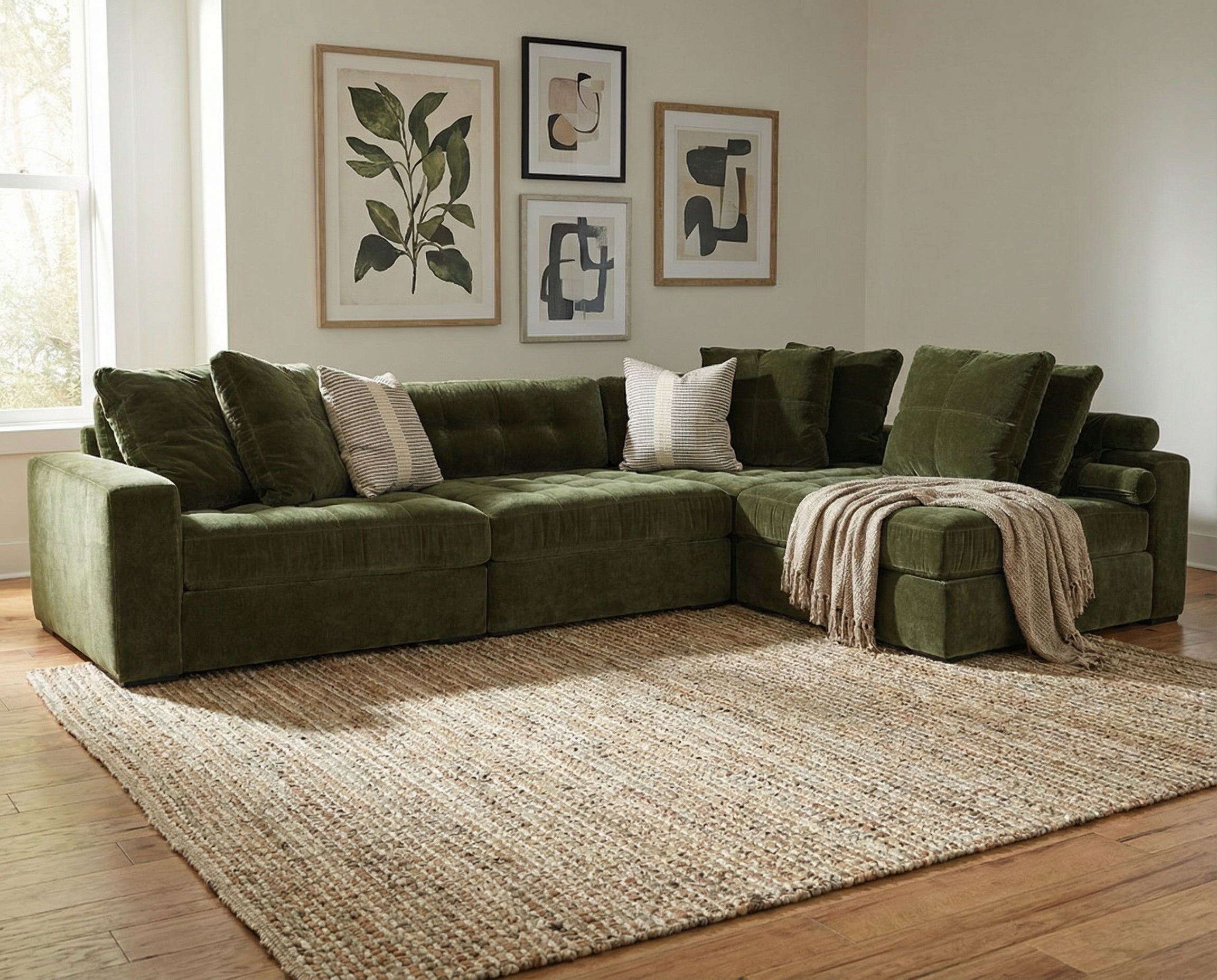
Start Type And Size
Loveseat
Two to two-and-a-half seats: Ideal for apartments, offices, bedrooms, or as an accent piece. Best for couples or secondary seating in a living room.
Sofa
Three or more seats: The everyday workhorse. Great for families, entertaining, or anyone who wants versatile seating for three to four people.
Sectional
Modular & expansive: Best for larger rooms, open-concept spaces, or families who want maximum seating and lounging room. Defines the room's layout.
Sleeper Sofa
Dual function: Works best in guest rooms or living rooms where overnight guests are frequent. Consider how often it will be used as a bed.
Questions to ask yourself
- Is this the primary seating in the room, or supplemental?
- How many people regularly sit here at once?
- Do you watch TV, read, work from home, or all of the above?
- Do you host guests regularly, and will they need to sleep over?
- Will the space ever be reconfigured or the furniture moved to a different room?
Measuring your space before picking it up or having it delivered
Measure twice, order once! Measuring is the most important, and most skipped step. Get this wrong and nothing else will matter.
- 36" Minimum traffic walkway clearance on any side of the sofa
- 18" Recommended space between sofa and coffee table for legroom
- 12” to 18" Ideal clearance from sofa back to the wall (allows for reclining)
- Two Thirds Rule: Sofa width should be roughly two-thirds of the wall it sits against
What to measure in your room
- Total room width and depth (floor to floor, wall to wall)
- The exact wall or zone where the sofa will live
- Ceiling height - affects how tall a sofa back will look proportionally
- Distance from sofa zone to TV or fireplace
- Windowsill heights - avoid blocking natural light
- Location of electrical outlets, cable ports, and floor vents
- Baseboard depth (can push a sofa further from wall than expected)
- Distance from sofa to other furniture (chairs, tables, rugs)
Pro Tip: Use painter's tape on the floor to mock up the sofa footprint before ordering. Live with it for a day or two. You'll know immediately if the size feels right in the space.
For sectionals, also measure
- Does the chaise, or return length, block a walkway?
- Which direction does the chaise face (left-facing vs. right-facing when seated)
- Corner clearance if placing in an L-shaped room or alcove
- Total assembled footprint (width x depth at the widest points)
For sleeper sofas, also measure
- Fully opened bed depth: most require 60" to 70" of clear floor space in front
- Room to access the pull mechanism from a standing position
Doorways, hallways & delivery logistics
Can it actually get into your home? A surprising number of sofas are returned because they can't make it through the door. Measure every path from the delivery truck to the final room.
- Entry door: Width & height must be considered. Measure the clear opening (not the frame). Standard doors are 32” - 36" wide. Allow for angling. You may need an extra 6” to 8" of clearance.
- Hallways: Width & turns. Tight turns are the biggest challenge. Measure the hallway width and the turning radius at every corner.
- Stairwells: Measure stairwell width, ceiling height at the first landing, and any half-wall rails. Don’t forget to consider rise (height of your stair steps). This is where most deliveries fail.
- Elevators: Depth and diagonal measurement determine if the sofa can be stood on its end. Get interior elevator dimensions from your building.
Many sectionals ship in multiple pieces, but the largest piece may still be bigger than you expect. Always confirm carton dimensions with your retailer, not just the finished furniture dimensions.
Delivery type matters
- White glove / Full service delivery: delivered, placed, and assembled in the room of your choice
- Threshold / Curbside delivery: brought to your front door or garage only
- Confirm whether old furniture removal is included or available
- Ask if legs are removable which can lower the piece by 3” to 5" for tight doorways
Room placement & layout
How does the sofa relate to everything else in the room? Where you place the sofa shapes how the entire room feels and functions. Think about anchor points, sight lines, and traffic flow before committing to a spot.
Play with our free room planner to help you visualize the space.
TV & screen placement
- Optimal viewing distance: 1.5 to 2.5 times the diagonal screen size (e.g., 65" TV = 8’ to 13’ feet away)
- TV should be at or slightly below seated eye level (42” to 48" from floor to screen center)
- Avoid placing sofa at a sharp angle to the screen. Off-axis viewing causes neck strain.
- Account for glare from windows. Consider sofa position relative to natural light sources.
- If a fireplace is present, is the TV above it? This affects ideal sofa distance and angle.
Traffic flow & room function
- Maintain 36" clear pathways around the sofa to all entry/exit points
- In open-concept spaces, the sofa often defines the room. Float it away from the wall to create a conversation zone.
- Consider where guests will sit when the sofa is occupied and leave room for accent chairs
Rug anchor & proportions
- A rug should be large enough for all front sofa legs, or all legs, to sit on it
- Rug should extend at least 18" to 24" beyond the sides of the sofa
- The sofa and rug together define the seating zone, plan them as a unit
For open-concept rooms, avoid pushing the sofa against the wall unless the room is very small. Floating the sofa creates a defined conversation area and makes the room feel larger and more intentional.
Fabric, Upholstery & Finish
Your fabric choice that determines how long it looks new.
|
Fabric |
Best for |
Watch out for |
|
Performance fabric |
Families, pets, high traffic |
Can feel less luxurious than natural fibers |
|
Leather |
Durability, easy cleaning, timeless look |
Cold in winter, hot in summer; can crack without conditioning |
|
Velvet / linen |
Formal rooms, low-traffic areas |
Shows wear and pet hair; harder to clean |
|
Microfiber |
Budget-friendly durability |
Can pill over time; may look flat |
|
Polyester blend |
Everyday use, color variety |
Less breathable; lower-end versions fade faster |
Key fabric questions to answer before choosing
- Are there pets in the home? Look for tight weaves and scratch-resistant performance fabrics.
- Are there young children? Stain-treated or solution-dyed fabrics are worth the upgrade.
- Do you or anyone in the household have allergies or sensitivities? Ask about CertiPUR-US foam certification and off-gassing.
- Are there removable, washable cushion covers? A huge practical advantage.
- What's the Martindale or Wyzenbeek "rub count"? Higher = more durable. Look for 15,000+ for everyday use.
- What is the cleaning code? W (water), S (solvent), WS (water and Solvent), or X (vacuum only).
Color & pattern
- Neutrals (warm gray, cream, greige) have the longest style life and resale flexibility
- Dark colors hide stains but show pet hair and dust more easily
- Pattern scale matters and larger patterns can overwhelm small rooms; keep patterns small or opt for texture instead
- Order a swatch and live with it in your room lighting (natural and artificial) before committing
Style & design
Looks matter, and so does longevity.
Contemporary
- Clean lines, low profile
- Works in modern and transitional rooms. Exposed legs, track arms, minimal tufting.
Traditional
- Classic silhouettes
- Roll arms, skirted bases, button tufting. Works best in formal or heritage-styled rooms.
Transitional
- The safe choice
- Blends contemporary lines with traditional comfort. The most versatile style for mixed-decor homes.
Casual / Coastal
- Relaxed & inviting
- Loose cushions, slipcover-style fabrics, lower arm heights. Built for comfort over formality.
Design details to evaluate
- Arm style: track (low, wide), rolled (classic), shelter (high, straight) which affects comfort and visual weight
- Back style: attached vs. loose cushions. Loose is casual and adjustable; attached is cleaner and more formal
- Leg height & style: exposed legs read as lighter and more contemporary; skirted legs are traditional and hide dust
- Leg clearance matters for vacuuming and cleaning under the sofa
- Sofa height: high-back for back support; low-back for open, airy look (but less support)
- Will this style still work if you change other elements of the room in 5 years?
Comfort & construction
What you can't always see is what matters most. Comfort is subjective, but construction quality is objective. A sofa that feels great in the showroom but sags in 18 months is a bad buy at any price.
Frame & support
- Kiln-dried hardwood frames are the gold standard because they resist warping and cracking
- Engineered wood (plywood, MDF) is acceptable in lower tiers but avoid particleboard in frames
- Corner blocking adds significant stability so ask your retailer if it's included
- Spring system: 8-way hand-tied springs are premium; sinuous (S-curve) springs are common and acceptable at mid-range
Cushion construction & seat depth
- High-resiliency (HR) foam holds its shape longer; low-density foam flattens faster
- Down-wrapped foam cushions are the most comfortable but require more maintenance (fluffing)
- Seat depth (front to back): 20” to 22" for upright sitting; 24” to 28" for lounging. Deeper is not always better as shorter individuals may feel lost in a deep seat.
- Seat height matters for ease of sitting down and getting up and that is important for older adults or those with mobility concerns
- ILD (Indentation Load Deflection) rating
- 15 to 20 is soft
- 25 to 35 is medium-firm
- 35+ is firm
Sit in the showroom longer than feels comfortable. Stay seated for at least 5 minutes in your natural position. If your back starts to ache or your feet dangle, the depth or seat height isn't right for you.
Durability, Warranty & Budget
Protect your investment
Warranties: ask about each separately
- Frame: look for lifetime on quality pieces
- Fabric/upholstery: typically 1 to 3 years
- Mechanism (for recliners/sleepers): typically 1 to 5 years; ask what's covered
- Cushion/foam: typically one to three years; defines acceptable wear levels
- Extended protection plan available? Linkey worth it for large investments and families with kids or pets.